Last updated:
Long Beach Marine Electric connects Long Beach boat owners with licensed, insured marine electricians for shore power repair and installation: pedestals that trip, inlets that have cooked, cords that have failed, and boats with no AC at the panel. The work covers 30A 125V and 50A 125/250V systems, onboard ELCI main breakers, and the leakage faults that newer 30 mA marina pedestals expose. Every visit starts with a leakage-current test, so you pay to fix the fault rather than to swap parts. If your plug or inlet is brown or melted, unplug it now and call.
What happens on the first visit
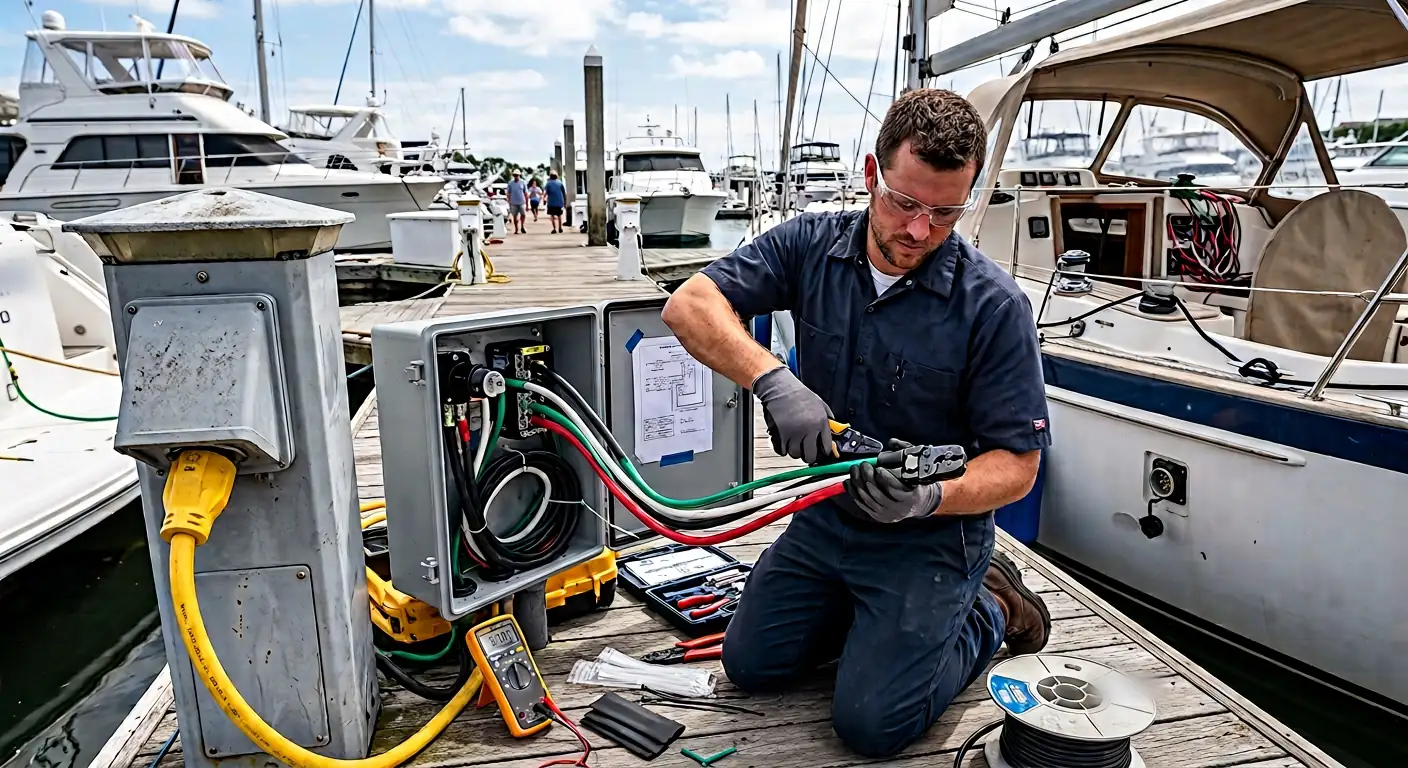
- Visual check of the cord, both plug ends and the boat's inlet for heat discoloration, corrosion and loose pins. Brown or melted plastic means the connection has been running hot.
- Polarity and voltage at the pedestal outlet and at the boat's main breaker, under load, so a weak dock connection isn't mistaken for a boat fault.
- Leakage-current measurement with a clamp meter around the shore cord (hot and neutral together). Anything that isn't near zero points to a fault on board.
- Circuit-by-circuit isolation: AC loads switched off one at a time (water heater, charger, inverter, A/C) until the trip stops, which identifies the faulty appliance or wiring run.
- A written finding with the fault, the fix, and a parts-and-labor price before any work starts.
Why boats in Long Beach marinas trip shore power more than they used to
Recent editions of the National Electrical Code have steadily tightened ground-fault protection at marinas. The 2023 NEC, section 555.35, sets the trip limit at 30 mA for each shore-power receptacle and 100 mA on feeders. Marinas that have rebuilt docks or replaced pedestals, including the multi-year Alamitos Bay Marina reconstruction, install equipment built to that limit. A boat that ran for years on an older pedestal with a small hot-to-ground or neutral-to-ground leak will trip the new one within seconds.
That trip is not a nuisance. It means current is leaving the boat by a path other than the shore cord, and that path can be the water around the hull. The code cites ABYC Foundation research identifying 30 mA as the level that prevents most electric shock drowning incidents. That's why the same 30 mA number appears on the dock and on board.
The five faults behind most shore power calls
- Neutral-to-ground bond on board. Common with household-style appliances and inverters wired without proper transfer switching. Under ABYC practice, neutral and ground are bonded only at the power source, never at a boat's panel while it's on shore power.
- Inverter or inverter/charger miswired. Panbo's reporting names inverters and reverse Y-adapters as the most frequent causes of ELCI tripping.
- Failed water heater element. A cracked element leaks current to the tank and trips the pedestal as soon as it heats.
- Hot, corroded inlet or plug. A loose or corroded pin raises resistance, generates heat and can melt the connector. AC faults between the pedestal and the boat's inlet are about 12% of boat fires in BoatUS insurance claims.
- Damaged shore cord. UV-cracked jacket, crushed conductors or a field-replaced plug with the wrong wire gauge.
Inlet, cord and ELCI: repair or replace?
A discolored inlet should be replaced, not cleaned: heat damage changes the spring tension of the contacts, and the connection will run hot again. The same goes for the cord end that mated with it. Most 30A inlets can be replaced from inside the boat in one to two hours. Boats that see repeated connector heating are often moved to a locking, sealed system such as SmartPlug.
If your boat has no onboard ELCI (equipment leakage circuit interrupter), the current ABYC E-11 standard calls for one at the main shore-power disconnect, with a maximum 30 mA trip level and 100 ms trip time. The exception is a boat whose isolation transformer is installed within 10 feet of the inlet. Adding an ELCI main breaker is a common upgrade after a marina pedestal change.
Insurance, warranty and who pays
Shore power work on a private boat is owner-paid. Insurance generally covers sudden damage, such as a fire, but not wear, so a marine survey finding like "shore power inlet shows heat damage" is a maintenance item you pay for. Pedestal and dock wiring belong to the marina; if the fault is on the dock side, the marina's own electrical contractor handles it, and the dockside test above tells you which side it's on before you pay for repairs.
What's included
- Leakage-current test of the full AC system
- Polarity and voltage check at pedestal and panel
- Inlet and cord-end heat inspection
- Circuit-by-circuit fault isolation
- 30A or 50A inlet replacement
- Shore cord and adapter replacement
- ELCI main breaker installation
- Written findings before work starts
DIY vs cheap fix vs proper shore power work
| Factor | DIY | Cheap operator | Proper marine work |
|---|---|---|---|
| Finding the fault | Try another pedestal | Replace the inlet and hope | Clamp-meter leakage test, circuit isolation |
| Burnt inlet | Sand the pins, plug back in | New inlet, old cord end | Replace inlet and mating cord end together |
| Pedestal trips | Cheater or reverse Y-adapter | Disconnect the water heater | Fix the leak or the N-G bond at its source |
| Leak protection | None | None | Onboard ELCI (30 mA / 100 ms, ABYC E-11) |
| Corrosion | Not checked | Not checked | Galvanic isolator or isolation transformer assessed |
| After the job | Unknown | Invoice | Re-tested at the pedestal, written findings |
Related resources
- Shore Power Installation Cost: Inlets, Cords, ELCI and Isolators (2026)
- Why Does My Boat Keep Tripping the Shore Power Breaker?
- Burnt Shore Power Plug: Is It Dangerous and What Should You Do?
- Marina ELCI Requirements: What NEC 555.35 and ABYC E-11 Mean for Your Boat
- Galvanic Isolator vs Isolation Transformer: Which Does Your Boat Need?