
Last updated:
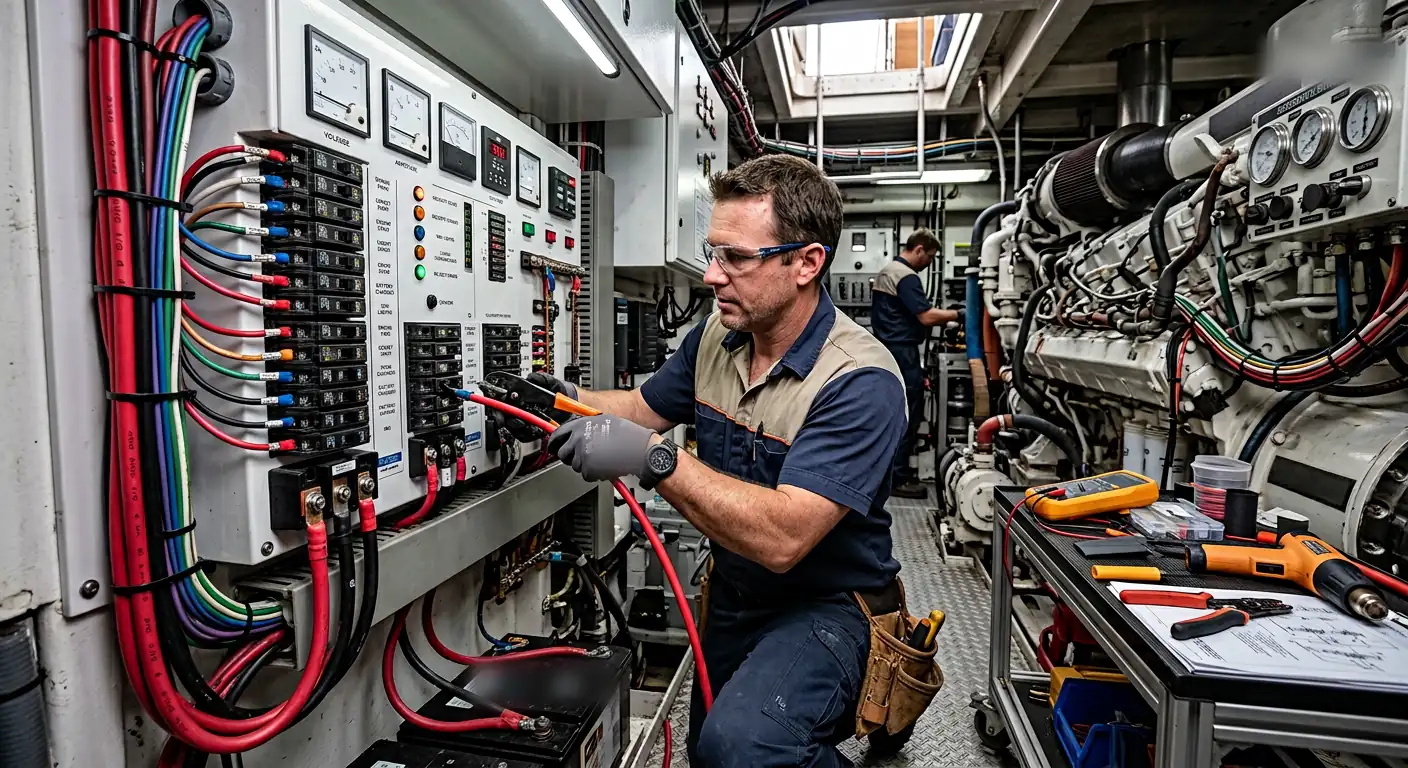
Long Beach Marine Electric connects boat owners with licensed, insured marine electricians for marine battery installation and charging repairs: replacement start and house banks, battery chargers, battery switches and combiners, and the parasitic-draw testing that explains why a bank goes flat between weekends. A dead bank is more than an inconvenience at the dock. It's also the bilge pump's only power source while you're away.
What happens on the first visit
- Load test of each battery, and a check of age and type. A 5-year-old AGM that tests weak is a replacement, not a mystery.
- Resting-voltage check after the boat sits, plus a measurement of current draw with everything switched off to find parasitic loads.
- Charger test on shore power: is it on, is it in the right mode for the battery chemistry, and is it actually delivering current?
- Inspection of terminals, cables, battery switch, fusing and hold-downs. Loose or corroded battery cables are a common cause of both no-start and fire.
- A written plan: what failed, what to replace, and a fixed price for parts and labor.
Why boat batteries die in a Long Beach slip
Batteries on boats that sit Monday to Friday usually die for one of three reasons. A parasitic draw keeps pulling current with everything off: a stereo memory, a bilge-pump float stuck in the up position, a carbon-monoxide detector or a miswired accessory. A failed or mis-set charger leaves the bank on shore power but never charging, or overcharges and dries it out. Or the batteries are simply at end of life. Flooded and AGM batteries are typically rated for 300 to 600 cycles at 50% depth of discharge.
A clamp meter on the battery cable with everything switched off answers the first question in minutes. A draw of even half an amp empties a 100 Ah usable bank in about 8 days. That's why a boat that was fine on Sunday won't start the following Saturday.
Choosing replacement batteries: flooded, AGM or lithium
Published 2026 price ranges for a 100 Ah deep-cycle battery are about $90–$150 for flooded lead-acid, $200–$400 for AGM, and $500–$800 for LiFePO4 lithium. Lead-acid batteries should only be discharged to about 50%, so a 100 Ah flooded or AGM battery gives roughly 50 Ah of usable power. A lithium battery can use 80–100% of its rating and is rated for thousands of cycles.
For most boats that sit in a slip on shore power, a like-for-like AGM swap is the sensible choice. If you anchor out, live aboard or run an inverter, a lithium conversion can pay back, but it's a system change, not a drop-in swap: charger, alternator and battery protection all need to match.
Chargers, switches and battery safety
A battery charger has to match the chemistry. AGM, flooded and lithium each need different absorption and float voltages, and a charger left in the wrong mode shortens battery life. Battery cables need overcurrent protection close to the battery, secure hold-downs so the bank can't shift in a seaway, and terminals covered against accidental shorts. Improper battery installation is a leading cause of the "other DC electrical" fires that account for about 15% of boat fires in BoatUS claims.
Insurance, warranty and who pays
Battery replacement is owner-paid. Batteries are a wear item that insurers don't cover unless they're damaged in a covered loss. Labor for a like-for-like swap is usually one to two hours. Charger replacement or a new battery switch adds parts and an hour or two. You get a fixed parts-and-labor price before work starts.
What's included
- Load test of every battery
- Parasitic-draw measurement
- Charger output and mode check
- Cable, terminal and fuse inspection
- Battery replacement and secure hold-downs
- Charger and battery switch installation
- Chemistry-matched charge settings
- Old battery removal for recycling
DIY vs cheap fix vs proper battery work
| Factor | DIY | Cheap operator | Proper marine work |
|---|---|---|---|
| Diagnosis | Buy a new battery | Swap the battery only | Load, draw and charger tests first |
| Bank | Mix old and new | Whatever's in stock | Matched type, age and capacity |
| Charger | Left on default mode | Not checked | Profile set to battery chemistry |
| Safety | Unfused, loose | Hold-downs skipped | Fused near the battery, secured, terminals covered |
| Result | Dead again next month | Dead again next season | Root cause fixed |